What does a healthy church look like?
There are lots of different lenses through which we can view church health. The Scriptures are full of examples of what it looks like to be healthy, growing Christians.
- Galatians 5:22-23 gives us nine characteristics of what it looks like to walk in the Spirit. We should expect to see these qualities in our churches: love, joy, peace, patience, kindness, goodness, faithfulness, gentleness and self-control.
- Paul’s letters, especially Colossians 1:3-8 and 1 Thessalonians 1:2-10, give us three characteristics of church health:
- Faith in the true gospel
- Hope in the returning Christ
- Love for one another
- In Revelation 2-3, we can identify seven attributes of a healthy church:
- Love (Thyatira had it, but Ephesus had forgotten its first love)
- Truth (Ephesus held firmly to the truth, but Pergamum and Thyatira had serious problems with lack of discernment)
- Service (Jesus says to the churches, “I know your deeds, your service, your work.”)
- Perseverance (Jesus commends four of the churches for persevering, remaining faithful and not giving up)
- Progress (Rev. 2:19 – Thyatira was not only serving and persevering, but also growing in what they are doing)
- Dependence (Smyrna, Pergamum and Thyatira demonstrated this. Sardis, however, thought it was doing well, while Laodicea did not recognise its need)
- Spiritual riches (Rev. 2:9 – the afflicted churches have true riches)
All these different angles are helpful in building up a clear picture of what a healthy church looks like. At Reach Ministries UK, we’ve found it particularly helpful to assess church health through the lens of the church as a body. In Ephesians 4:15-16, Paul describes the church as a body growing up into Christ:
“Instead, speaking the truth in love, we will grow to become in every respect the mature body of him who is the head, that is, Christ. From him the whole body, joined and held together by every supporting ligament, grows and builds itself up in love, as each part does its work.”
The body grows as each part does its work, together becoming more like Christ. It is therefore important to consider the interconnected whole when assessing church health. Different church ministries cannot properly be understood in isolation, because what happens in one area affects all the other parts.
The importance of careful diagnosis
Imagine a church where relatively few people are involved in ministry. On the surface, this might simply look like a problem with equipping workers, and there may well be an issue with training and equipping. However, the picture of an interconnected, organic system encourages us to consider this problem in relation to the whole.
Perhaps there are weaknesses in teaching and people’s understanding of their calling to serve. Perhaps there is a weakness in the engage/membership ministry, so people don’t really feel that this is their church. Perhaps there is a lack of outward-facing evangelistic endeavour, meaning that the only opportunities to serve are inward-facing. The visible symptom is a lack of workers. But the underlying causes may lie elsewhere.
The human body provides a helpful illustration. Sometimes pain is felt in one place even though its cause lies somewhere else. A problem with the way a person walks can place strain on their back. Tension in the neck can contribute to a headache. Treating the painful area alone may bring temporary relief, but without addressing the underlying problem the pain won’t go away. Churches can be similar. A lack of enthusiasm or effectiveness in one area of church life may have multiple causes.
Equally, when we strengthen one area, there will be consequences elsewhere. These may be positive or negative. When you develop one area of your body in the gym, for example, you can put strain on another area. Investing more resources in one ministry usually means giving less attention to other ministries. That doesn’t mean we should never prioritise, but does mean we should think carefully about the whole body when we do.
This is why we need to be careful about rushing from symptom to solution. Before asking, “What should we do?”, we need to ask, “What is actually going on?” Before prescribing a treatment, we need to take time to diagnose.
The interconnected ministries of a church
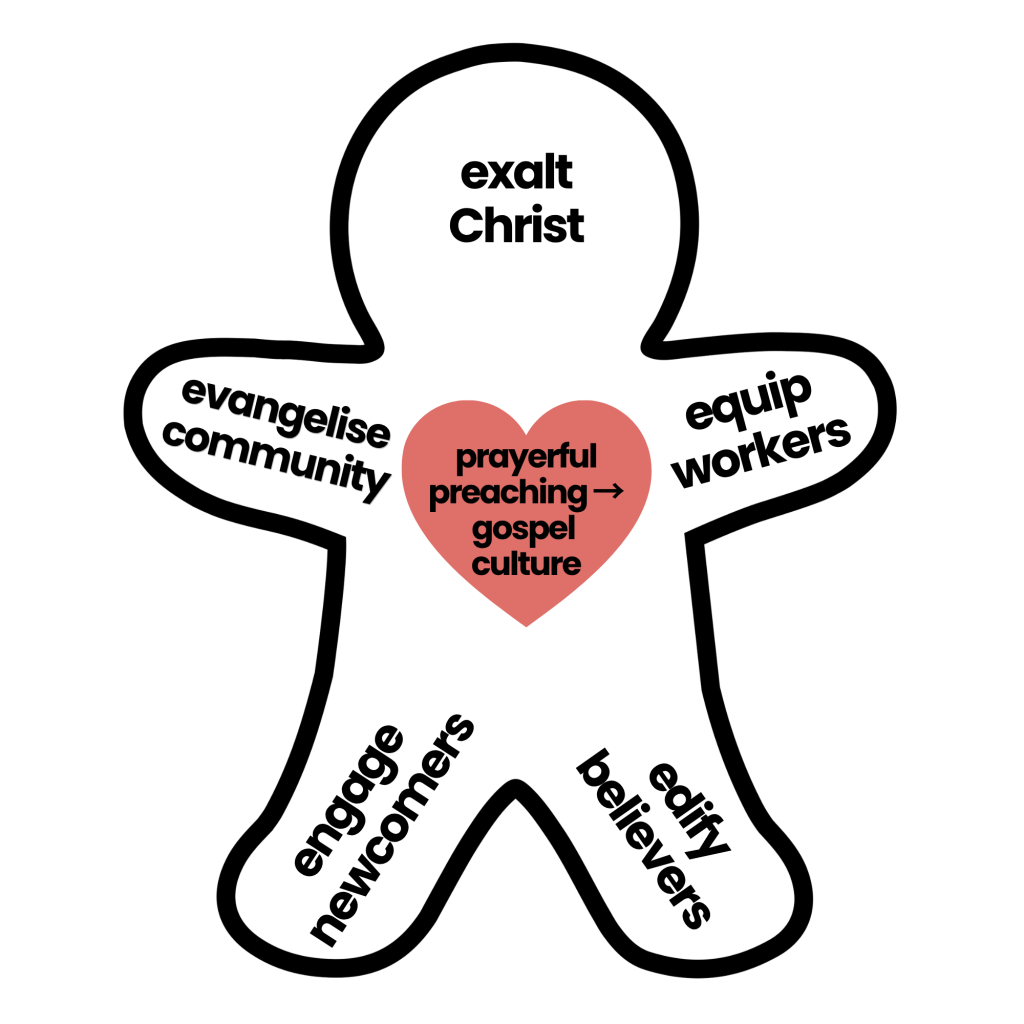
This is the thinking behind our new Gingerbread Church Assessment Tool. Designed to encourage an honest self-assessment of how your church is functioning, the tool considers five interconnected ministries, all fuelled by one heart.
- Exalt Christ — Does the church present Christ as supremely worthy? Is the church’s life shaped by the desire to know, love, worship and exalt him?
- Evangelise Community — Is the church proclaiming the gospel and seeking to make Christ known in its community and beyond?
- Engage Newcomers — How effectively does the church welcome people and help them become part of the life of the body?
- Edify Believers — How well is the church helping believers grow towards maturity in Christ?
- Equip Workers — How effectively is the church equipping its members to participate in the work of ministry?
Bible teaching at the heart
At the centre of this picture is the ministry of God’s Word. God’s Word shapes the convictions that drive the whole life of the church. Just as the heart in a healthy body pumps life-giving blood through the arteries to all the organs and limbs, so Bible teachers bring the life-giving Word of God into all the ministries of the church. The health of the heart really matters. It is central to the health of the body. But the point of the heart is a healthy body, not just a healthy heart. Biblical truth is not meant to remain confined to one part of church life; it should flow through everything.
Gospel culture
Also at the heart of the church is its culture – “the way we do things around here”, “the air that we breathe”. A healthy church not only preaches the gospel but also walks in step with it. So, as well as asking questions about Word ministry in the church, the Gingerbread Assessment asks questions about:
- The church’s gospel vision
- Its disciple-making pathway
- Gospel-shaped leadership
These are things that shape and influence everything else.
The importance of thinking before acting
One of the purposes of the assessment is to help churches slow down before they rush into implementing changes. We know how frustrating it can be when a GP starts writing a prescription before you’ve even finished explaining your problem! Just as we want our GP to take the time to listen and understand, a careful church assessment helps us slow down and ask better questions:
- What exactly is happening?
- Where is there health and where is there dysfunction?
- What might be contributing to it?
- Are there convictions or assumptions underlying the problem?
- What other areas of church life might be connected to it?
- If we address this particular issue, what impact might that have elsewhere?
The Gingerbread Tool helps create space for those kinds of questions. It brings together input from a range of perspectives to help a church identify patterns that might otherwise be difficult to notice. The results may raise uncomfortable questions, but they provide a starting point for prayerful reflection and careful diagnosis.
The Gingerbread Church Assessment Tool
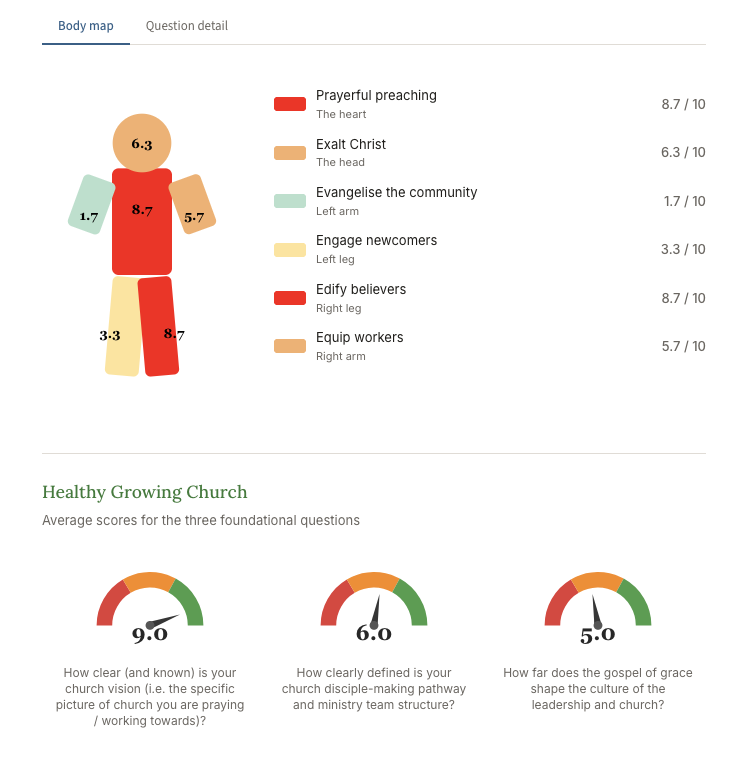
Our Gingerbread Tool uses a short questionnaire that can be completed by your staff team, leadership team or even your whole church family. Once everyone has responded, you’ll be able to review and download a report showing which areas are flourishing and where the pain points lie.
After you’ve received your results, you may value an external perspective on the findings and some help drawing conclusions. If so, please get in touch to arrange a half-day session with one of our consultants. They’ll help you diagnose what’s really going on, and work with you to develop a treatment plan.
Example report showing body map image of survey results. The report will also give more detail on the responses to each question individually.