Insights from the 2026 National Ministry Survey
When we compare the results of our 2026 National Ministry Survey with the equivalent data from 2021, some striking changes emerge alongside some persistent challenges.
Here are some of the most notable developments:
1. Church growth has increased dramatically
Perhaps the most striking finding is the change in reported church growth.
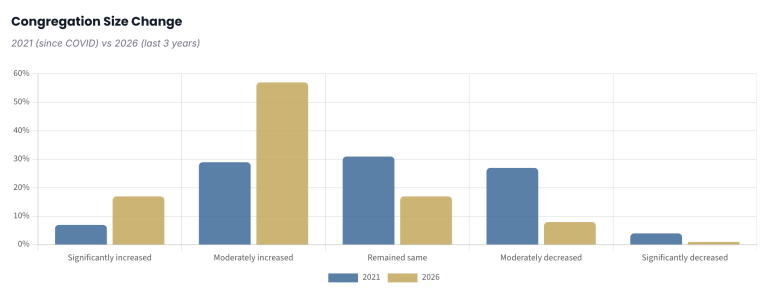
Beyond the broadbrush picture of churches growing – digging into the detail of actual conversions per church – it gets even more encouraging. The data shows a near-doubling of reported new Christians per church, from an average of 7.8 over three years to 16.0 (equivalent to 2.6 per year jumping to 5.3 per year). If you look at that as a proportion of overall Sunday attendance, that is a jump from a conversion growth rate of 2.4% (2021) to 4.6% (2026). Those figures include ‘returnees’ – lapsed and nominal believers coming back to church after many years. If you remove those and focus only on conversions from an unchurched background the growth rate has shifted from 1.7% per year to 2.3% per year. Not as high as we would love to see but still a very encouraging trend.
2. Pastoral energy appears to be recovering
There is a similar pattern when we look at leaders’ experience of their own ministry.
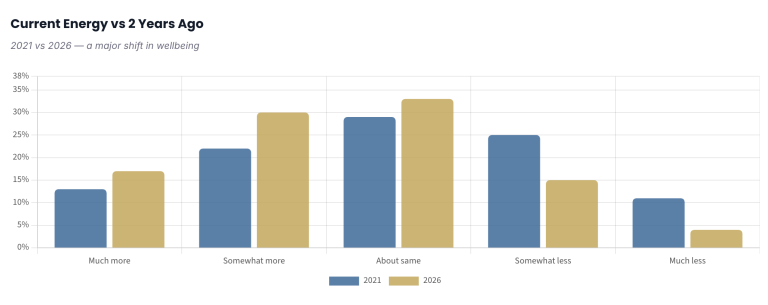
In 2021, 35% of leaders reported feeling more energised (compared to two years prior). By 2026, that had increased to 48%. Meanwhile, the proportion reporting that they were less energised fell from 37% to 20%. This suggests that the exhaustion and discouragement experienced by many leaders around the pandemic period may have eased for a significant proportion.However, we should be careful about causation. The survey doesn’t establish that the pandemic was the sole cause of lower energy in 2021, nor that the subsequent increase is entirely a result of recovery from COVID-19. And it should be said that an energised leader is not necessarily a better leader – energy levels are not a measure of ministry effectiveness. But the change does suggest a greater level of optimism and capacity for a new season of gospel endeavour.
3. Consultancy appears to be reaching more leaders
Another encouraging change is with coaching/mentoring.
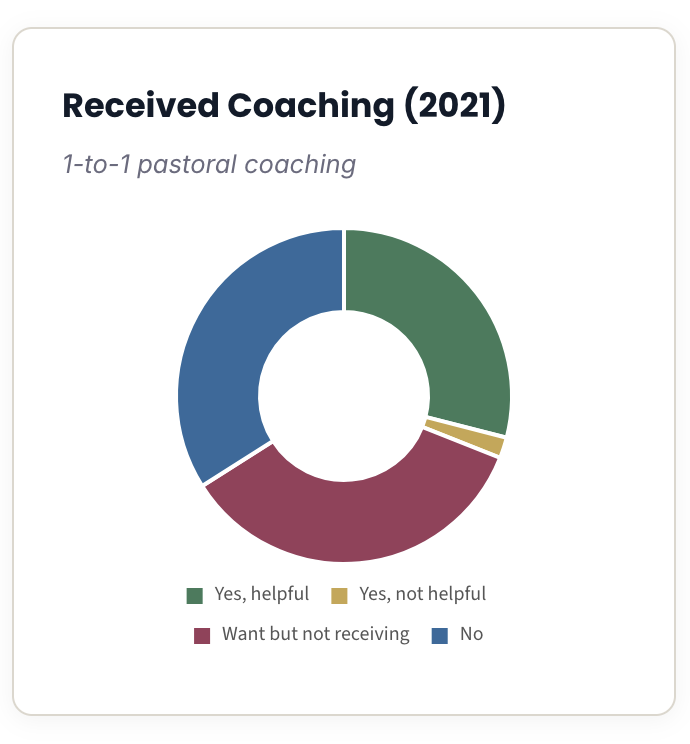
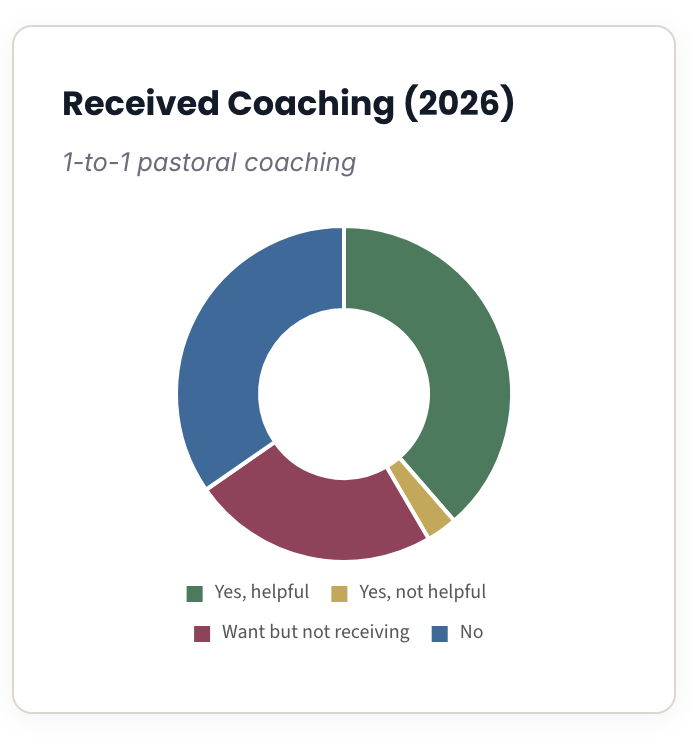
The data doesn’t tell us whether the increase in coaching and mentoring being provided is responsible for improvements elsewhere in the survey, but the correlation is interesting and at least we can note a growing normalisation of the practice of leaders giving and receiving 1-to-1 consultation.
The survey also points to a rise in those receiving external assessment of their ministry.
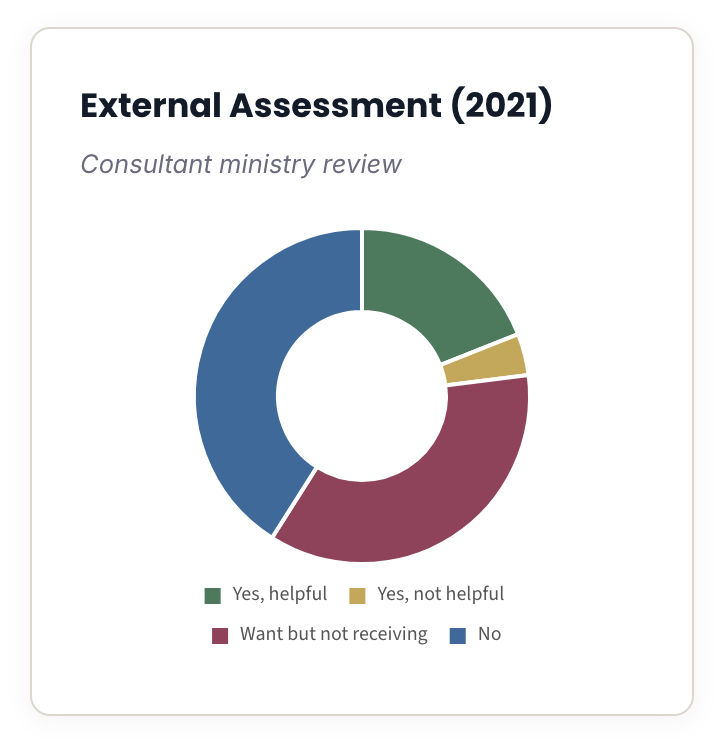
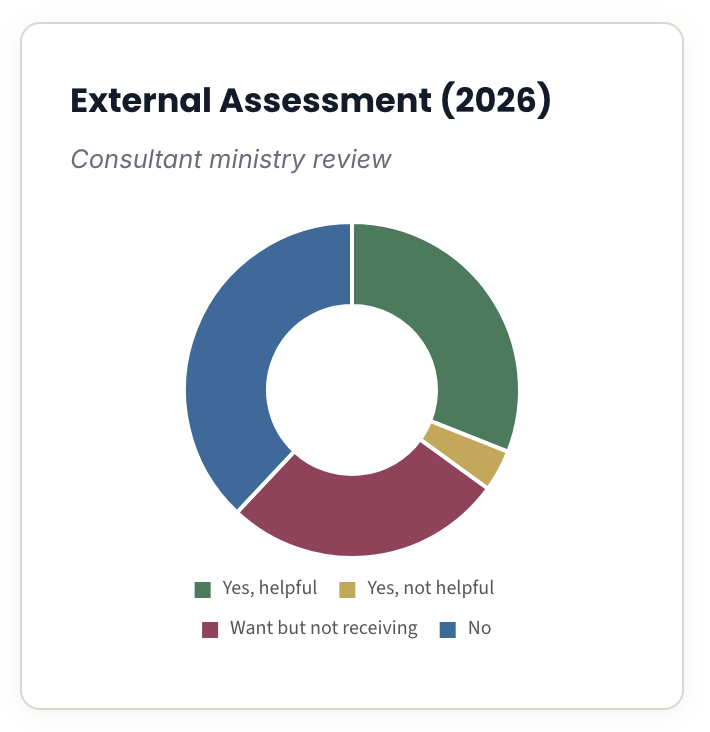
In 2021, 23% of respondents had experienced some kind of external assessment. In 2026, that figure had risen to 35% (over half as many again). Of these, 79% had found the process beneficial as reporting in the 2021 survey compared to a 87% satisfaction rate in 2026. It seems that churches and leaders are becoming more comfortable with the idea of looking outside themselves for perspective and are also having increasingly good experiences of such assessments – helping them see where they are and where they could get to more clearly.
4. Church planting ambition is modest but many are open to starting a new service
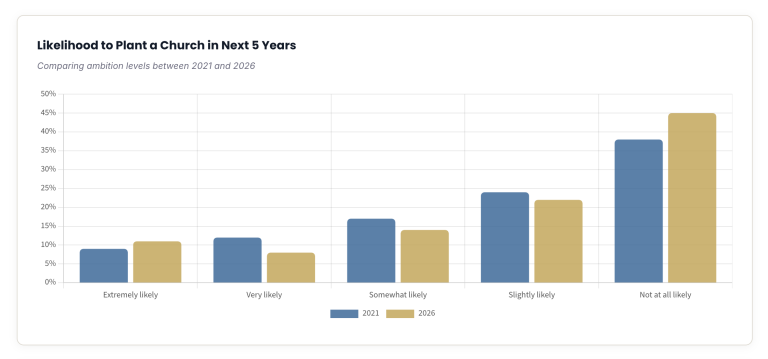
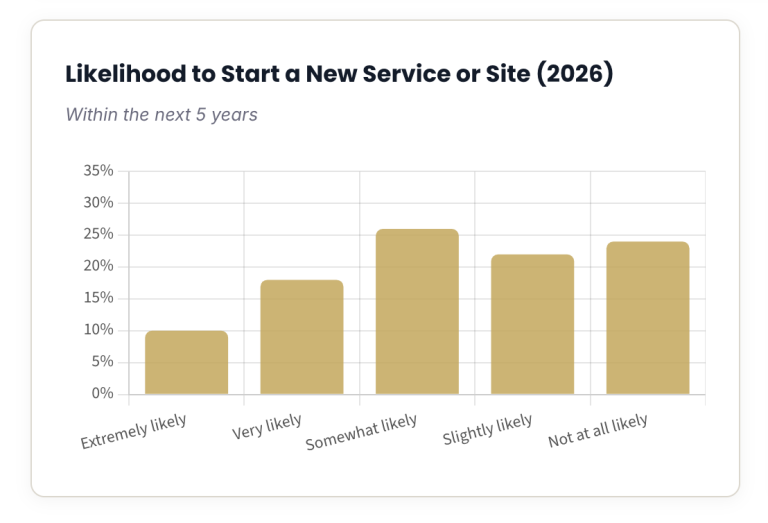
Comparing these results with the rest of the report, it is interesting that the growth in church attendance, evangelistic fruit and leadership energy has not been accompanied by a corresponding increase in church planting ambition. One possibility is that this growth and energy is being directed towards plans to add a new congregation to an existing church or go multi-site. In a new question in the 2026 survey, 28% of church leaders reported that they were extremely or very likely to start a new service or site in the next 5 years; in fact over three quarters thought that was to some degree likely.
5. There is a lot of hunger for practical training
Perhaps the most striking result in the 2026 survey is that 94% of church leaders surveyed said that they would value support in at least one of the 16 aspects of church ministry listed. Of these the most requested – mentioned by 44% of leaders – was ‘next generation leadership development’ – a need which makes the training focus of the Reach Ministries UK National Conference particularly timely.
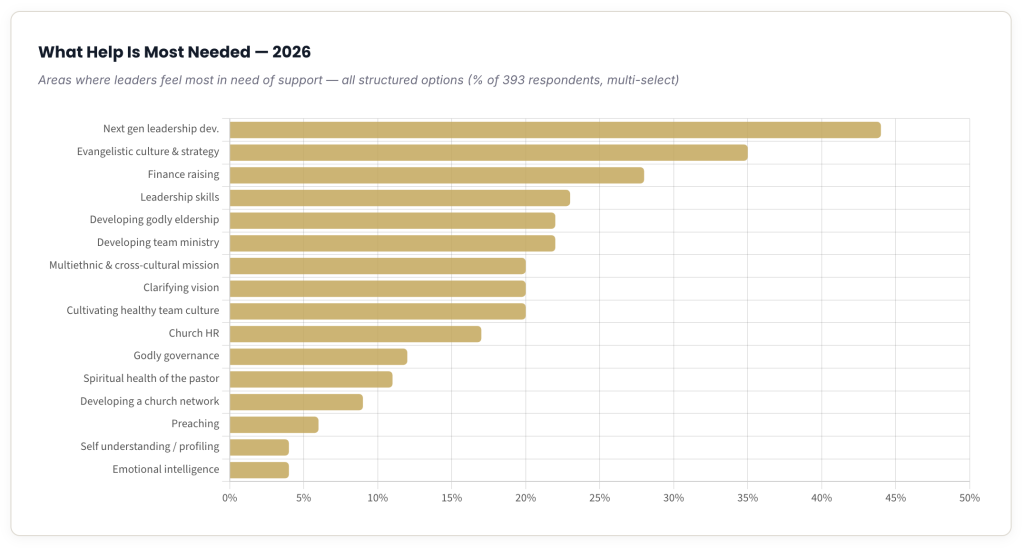
When asked specifically about training in preaching a significant minority responded by saying that there was good training input available on exegesis and exposition but what they lack is an environment for peer feedback and coaching in good application and delivery. That is something that has prompted the new Prepared to Preach cohort.
"I've had very little feedback [on my preaching] since leaving a larger staff team — few have the confidence to critique the senior pastor. I'd like to know more about what is actually being heard by hearers."
2026 Survey Respondent
An encouraging picture
The most obvious interpretation of this survey data is that there are significant signs of recovery and renewed confidence in church ministry.
More churches report growth; fewer report decline.
More leaders report feeling energised; fewer report feeling depleted.
More leaders are receiving helpful consultancy and church assessment. Fewer say they want it but cannot access it.
And the vast majority of church leaders surveyed want more help to do better; which itself shows a wonderful humility and healthy ambition to reach the lost.
Methodology:
The two National Ministry Surveys were in the field 17 Sept – 11 Oct 2021 and 16 March – 9 April 2026 respectively. The same question wordings were used plus the addition of some new questions in the later survey. The 2021 survey was completed by 584 church leaders while the 2026 was completed by 393 church leaders. The leadership profile was very similar in both cases (around 73% senior pastors) and the geographical profile (regional splits and urban/suburban/rural) was also similar (well spread and varied on both occasions), but the 2026 survey did have a somewhat older profile of respondents (39% aged 57+ compared to 19% in the 2021 survey), slightly more women (12% compared to 4%), less FIEC churches (30% in the 2026 survey compared to 61% previously) and churches skewed slightly larger (71% over 50 adults compared to 60% over 50 previously – which could be a result of growth!).